The artist's life
Born into a family of musicians, Anastasia Kobekina was born in Yekaterinburg in 1994. She took up the cello at the age of four and gave her first concert with orchestra at six. After more than promising beginnings, Anastasia went on to perform with leading orchestras such as the Russian National Orchestra, the Moscow Virtuosi, the Mariinsky Orchestra, the Vienna and Warsaw symphony orchestras and the Camerata Baltica. Anastasia has worked with many renowned conductors, including Vladimir Spivakov, Krzysztof Penderecki, Heinrich Schiff and Valery Gergiev.
Awards
She has also performed as a soloist on such prestigious stages as the Konzerthaus Berlin, New York’s Lincoln Center, the Great Hall of the Moscow Conservatory and the Bolshoi Theatre. After earning her diploma at the Moscow Central Music School in 2012, she continued her studies as a young soloist at the prestigious Kronberg Academy in Germany under Frans Helmerson, funded by the Steigenberger/Rath Scholarship. As talent does not wait for age, Anastasia has played chamber music alongside leading figures in classical music such as Gidon Kremer, Yuri Bashmet, Fazıl Say, Denis Matsuev, Vladimir Spivakov and András Schiff. Anastasia has won several competitions, including the Landgraf von Hessen Award and the Boris Pergamenschikow Scholarship of the Kronberg Academy in Germany; she was a finalist at the Eurovision Young Musicians competition in Vienna, a semi-finalist at the Tchaikovsky Competition in 2015 and, that same year, won the Verbier Festival Academy prize in Switzerland and First Prize at the TONALi Music Competition in Hamburg. After hearing her play the Haydn concerto conducted by Vladimir Spivakov at the Annecy Classic Festival in 2014, Pascal Escande decided to invite her to the Festival d’Auvers-sur-Oise the following year, together with her friend the pianist Anna Fedorova — winner of the Denis Antoine Prize of the AVC Charity Foundation at the Piano Campus international competition — in order to record her first DVD on the DiscAuverS label.
That DVD was a success, and the music world began to hear about Anastasia’s extraordinary talent. Renaud Capuçon then invited her to the 18th “Sommets Musicaux” in Gstaad, where she received a double distinction: the Thierry Scherz Prize, sponsored by the Pro Scientia et Arte Foundation, and the André Hoffmann Prize. A few months later, Renaud Capuçon invited her to the 6th Easter Festival in Aix-en-Provence, where Anastasia played Rachmaninov’s Sonata in G minor with the pianist Jérôme Ducros, earning the praise of the national press, which saw in her the true revelation of that edition.
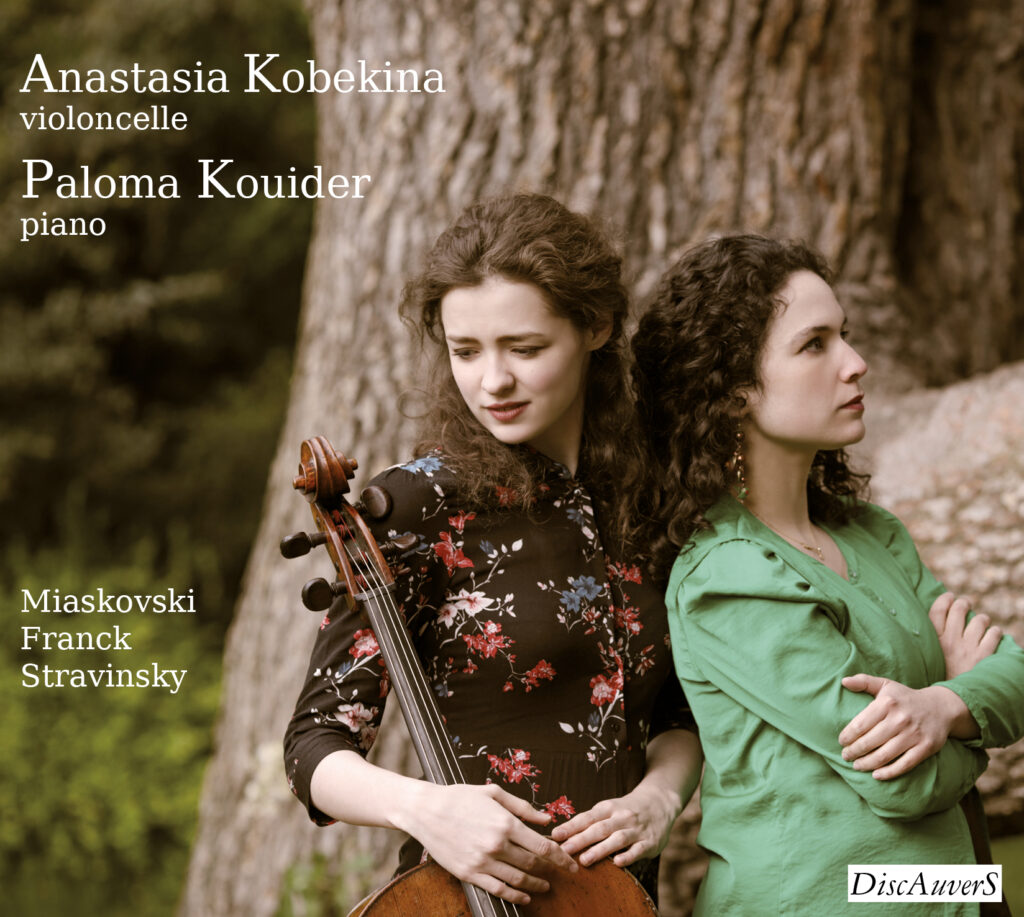
2018 was another fruitful year, notably in October at the Cello Biennale in Amsterdam, where Anastasia played the concerto for two cellos and orchestra “Antidotum Tarantulae XXI” by and with Giovanni Sollima and the Netherlands Philharmonic Orchestra, and then in Paris at the Salle Cortot on 11 October 2018 for the official release of her first record, produced by DiscAuverS, with her partner the pianist Paloma Kouider, in a programme of Miaskovsky, Franck and Stravinsky.
After her studies in Berlin in the class of Professor Jens Peter Maintz, Anastasia Kobekina began a Master’s degree at the Conservatoire National Supérieur de Musique et de Danse de Paris in the class of Jérôme Pernoo from September 2018.
Anastasia plays a Giovanni Guadagnini cello of 1745.
Link with the Festival
An “Adami classical revelation” and a laureate of the Fondation Groupe Banque Populaire, Paloma Kouider trained with Sergueï Markarov at the École Normale de Musique de Paris and with Elisso Virsaladze in Florence, before joining the class of Avedis Kouyoumdjian at the Universität für Musik und Darstellende Kunst in Vienna. Invited from a very young age to appear in prestigious programmes as a soloist, in chamber music and with orchestra, Paloma has never set aside another passion — literature — which she pursued in a literary preparatory class at the Lycée Louis-le-Grand, encouraged by a First Prize at the Concours Général des Lycées. It is a passion she shares with her colleagues in the Trio Karénine — Fanny Robilliard on violin and Louis Rodde on cello — who have won, among other distinctions, the prestigious ARD Competition in Munich in 2013, the international Pro Musicis Prize in 2011 and the Nordmetall Ensemble Preis of the Mecklenburg-Vorpommern Festspiele in 2015, with double bass player Laurène Durantel and violist Krzysztof Chorzelski, for their interpretation of Schubert’s Trout Quintet. Alongside her work with the Trio Karénine, Paloma regularly collaborates with the cellists Aurélien Pascal and Anastasia Kobekina — with whom she received the André Hoffmann Prize at the Sommets Musicaux de Gstaad — as well as with the violinist Alexandra Soumm. Certain musical encounters have particularly marked and shaped her artistic path, notably at the Villecroze and Musique à Flaine academies: the Ysaÿe Quartet, Hatto Beyerle, Menahem Pressler, Alfred Brendel, Ferenc Rados, Jean-Claude Pennetier, Paul Badura-Skoda, as well as Claude Helffer for contemporary music and Stéphane Béchy for the performance of early music on period instruments.
Her past and future engagements include the festivals of Aix-en-Provence, Radio France and Montpellier, Pablo Casals, Menton, La Roque d’Anthéron, Auvers-sur-Oise, the Piano Folies du Touquet and the Folles Journées in Tokyo, the Salle Gaveau, the Salle Pleyel and the great hall of UNESCO in Paris, the “Stars von Morgen” series in Berlin, Wigmore Hall, the Herkulessaal and the Prinzregententheater in Munich, and the Laeiszhalle in Hamburg… A regular guest on radio, her first recording, devoted to Beethoven and Liszt and released in September 2010 on the Lyrinx label, was acclaimed by the French music press, as were those of the Trio Karénine (Schumann, 2016; Ravel, Fauré, Tailleferre, 2018, for the Mirare label) and the one recorded with the violinist Fanny Robilliard (Evidence Classics).
Deeply committed to helping those most in need, Paloma founded, together with Alexandra Soumm and Maria Mosconi, the association “Esperanz’Arts”, which organises artistic events for everyone.
“The Pastoral comes close to the great masters of the modern era (Brendel, Barenboim, Perahia…), in its intelligence and its clarity.” (Etienne Moreau, Diapason)
“It is splendid in its intelligence, its musicality, its personality. A real discovery.” (Gérard Mannoni, Classica)